
a chicken => one of (chicken)s / a c_chicken of u_chicken (countable: c_chicken, uncountable: u_chicken) cf. a c_bottle of u_water
"bottled water"...a bottled water industry, a bottled water business, a bottles water ad, a bottled water service...
"give me bottled water" 53600 / "give me a bottled water" 6300 / "give me a bottle of water" 171000 / "give me water" 3330000
chickens => one of (chickens)s / indefinite(c_chickens) of u_chicken cf. "birds of prey":Falcons are birds of prey in the family Falconidae.
cf. 'Fifty Shades Of Chiken' Cookbook Brings The Sexy Back To Poultry

The dog is walking around the table. He only earns enough to barely get by. => Japanese are walking around barely getting by. Metaphor!!
cf. "Japan had zombie corporations, we have zombie consumers who are just walking around barely getting by."
"I had a cup of coffee this morning." => (1) Agent "I was a person who had a cup of coffee this morning."
(2) Object "A cup of coffee was something to which I had this morning." / (3) Time "This morning was a time when I had a cup of coffee."
"I had a cup of coffee for staying awake this morning." => (4) Goal "Staying awake was a goal for which I had a cup of coffee this morning."
Copulative sentence is likely to be used by native Japanese speakers on the deep structure without awareness. It causes confusion.
The postpositional particle '-wa' substitutes for the case markers ('-ga' for agent and '-wo' for object) or connects backward to others.
NP which ends up with '-wa' on the surface looks like a subject for Japanese. Then they think the structure as previously cited (1)-(4).
"I read a book." => "Watashi-ga hon-wo yomimasu." => "Watashi-wa hon-wo yomimasu." => "I am a person who reads a book."
The less frequently used NP is "watashi-ga" on ordinary context because nominative case has a tendency to specify for expressing modality.
"I read a book." => "Watashi-ga hon-wo yomimasu." => "Hon-wa watashi-ga yomimasu." => "A book is something which I read."
If someone said to my naughty servant "Mind you do not upset your master!" How can we say it in other words?
"You should not make your master worry!" can be the one of right answers without the people who have used English dictionaries made in JPN.
For example, the "Unabliged Genius" dictionary gives a bad indication of how we know the speaker's intention in this case.
It leads to misreading of which meant "You should not overturn your master!" What is the cause of this error? Maybe changes with speed.
"Pocket Oxford" published 1992 has a same view on meanings of "upset" with ENG-JPN dictionaries, but "Wordpower" 1993 has other opinions.
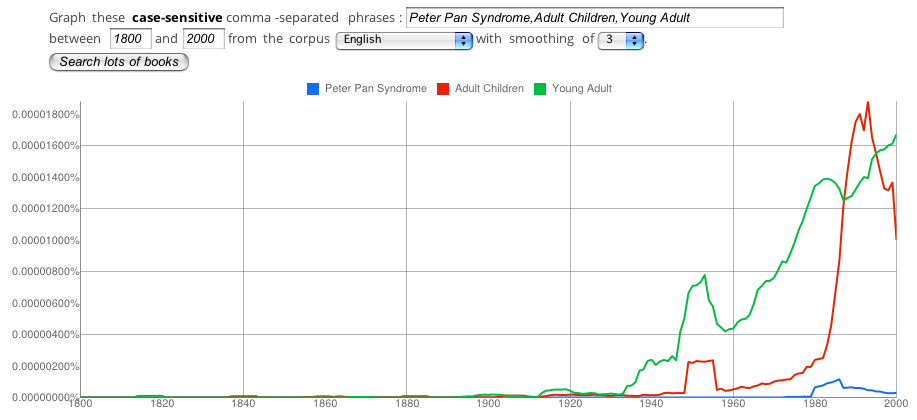
Carson McCullers made up "Young Adult" characters in her novels in 1940's. It went over well with the public.
There is some likelihood of having the first knowledge of "Young Adult" generation forming quickly.
Compared with this, "Adult Children" has an explosion since the late 80s. In 90s, the popularity of this term even exceeded "Young Adult".
We can figure out the boom in "Peter Pan Syndrome" as the initial explosive. Since then, people came to view it as a mental disorder.
Google gives an indication of vindication... >> http://goo.gl/cKIzB
>> 
departing winter / washed away her father / onto a shore
As someone point out, a metaphor is regarded as an abbreviated similie within Japanese native speakers.
In turn, a synecdoche is a subpart of metonymy.
Anyway they can not find out essential differences between figures.
Former distinction rests in differences of copula functions between Japanese and others.
Latter is tied to cognitive value of sigular-plural sets, I guess.
Japanese have a pronounced tendency to forget giving a definite/indefinite article as above :p
[similie or metaphor] I feel like I have small bags of sand sewn inside my chest and face.
[similie or metaphor] The listener will understand what you are saying but will privately think, you aren't the brightest tool in the shop.
In times of shortly before sundown, a herd of deer came out of the grove. The hart rang its screamings, three times in a row.
These sounds were accepted as a sorrowful and forlorn expression by customs of other days.
In terms of zoological concept, it sounds a warning that estral harts claim females as their own. That may be so.
I felt as if these sounds were activated by selfish motives. They were mere animals and I have not encountered St Hubertus deer and all yet.
>> Non-interference in the number of lexical items on MDS results
The aim of this paper is to suggest that the number of lexical items can not have a major influence on MDS analysis. As the first step in the verification process, we take "offender profiling" as an object of study. Several observation in diverse text mining researches have shown that this issue may depend on a visibility of maps. With the use of "The Blue Book", we explore in to the effects of various settings of lexical items .
>> Collocation and Message interpretation of a Japanese Text
In this paper we will suggest that it will be useful for interpreting the message(s) of a Japanese text to visualize its frequencies of lexical collocations. The visualization is based on MDS. We explore into the effects of various settings of span. Span is currently considered to be the central parameter of the notion "collocation" in that two elements are said to be in collocation when they cooccur in a certain specified span. It is shown that various settings of the span length do not significantly affect the final configurations obtained through visualization, when span is defined with non-lexical, i.e. functinal, elements excluded. The result supports our initial suggestion because the message of a text we are trying to capture is one of its constant properties.
>> Message Analysis Focused on Collocations in Kuki Syuzo's Texts unpublished
The aim of this paper is to distill the messages from the corpus of Kuki Shuzo’s writings by using the computational statistics. Specifically, through the analysis of collocation that is difficult to define, availability for decoding messages of unique patterns denoted cooccurrence relation between lexical items is revealed. Quantification method in this paper is mainly metric multidimensional scaling (MDS) and then results are divided in the groups by hierarchical cluster analysis. Based on an assumption that clusters are composed of maldistributed lexical items and exhibit the particular meanings, it turns out the messages as a semantic structure of the corpus. Major part of Kuki’s corpus are riddled with abstruse notion, however, this method make it possible to be helpful for understanding and supporting literary studies. Originality of this method is also mentioned by comparing MDS with correspondence analysis.
>> Content Analysis of Japanese Literary Works Using a Computer
What I wish to show in this paper is a new point of view for content analysis of Japanese corpora. The first section gives a concise introduction to advanced research about three disciplines, namely content analysis, corpus linguistics and natural language processing. The second section proposes and discusses the hypothesis that “content-sensitive word (CSW)” will emerge from “high-frequency vocabulary (HFV)” by statistical methods such as metric multidimensional scaling and principal component analysis. This hypothesis makes it possible to use a computer for the content analysis of a target corpus that is constituted of literary works belonging to a specific author or school. Then, two important terms, “cooccurrence value” and “scope of high-frequency vocabulary”, are defined here. The remaining part of the paper introduces a sample analysis of Kuki Syuzo’s essay and criticisms on his literary works. At last, a Perl script for analyzing a Japanese corpus is appended as a supplement.Copyright(c)2012 ccoe@mac.com Allrights reserved.